
NEWS
IN BRIEF
On 23–25 October 2025, Accountability Lab East and Southern Africa […]
SHARE
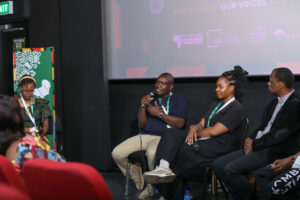
On 23–25 October 2025, Accountability Lab East and Southern Africa (ALESA) participated in the Afrotellers Conference in Johannesburg, South Africa, to advance the Lab’s mission of promoting citizen-centered governance through creative storytelling. The convening brought together storytellers, creatives, academics, activists, and development practitioners from across the continent under the theme “Our Stories, Our Voices, Our Power.” It explored how narratives shape transformation, voice, and power, aligning closely with ALESA’s belief that storytelling can shift mindsets, inspire action, and make governance more relatable and inclusive.
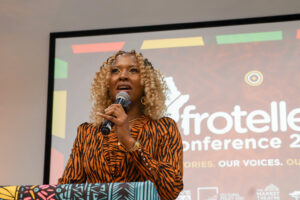 Now in its second edition, Afrotellers 2025 was co-hosted by ALESA’s Media and Communications Officer, Bathabile Dlamini. Over three days, the conference examined the sub themes of Stories, Voices, and Power, looking at storytelling as a tool for healing, examining who gets to speak and be heard, and exploring how narratives can mobilize movements and shape just futures. ALESA’s participation highlighted the organization’s creative storytelling capacity through performances, facilitation, and curated storytelling experiences led by its staff and Arts for Change alumni.
The opening plenary, titled “Our Stories, Our Voices, Our Power,” set the tone for the conference. ALESA’s Associate Director for Programs and Campaigns, Beloved Chiweshe, spoke passionately about the power of creativity in advancing justice and accountable governance. He shared insights on ALESA’s Arts for Change program, which uses film and music as primary artistic means to drive civic engagement and inspire positive social change.
Chiweshe emphasized the Lab’s “Them Not Us” approach, which centers youth and communities as co-creators of accountability and drivers of change. The session, moderated by Michar Mushiko, also featured contributions from Dr. KG Moshugi, an Afrotellers advisor and researcher at the University of the Witwatersrand; Adanma Yissa, founder of The Decoloniality Network; and creative entrepreneur Mpumelelo Mfula. The panel sparked engaging discussions among participants who resonated with ALESA’s creative and inclusive approach.
Many attendees expressed appreciation for the relatable nature of ALESA’s work and encouraged the inclusion of more diverse art forms, such as fashion, photography, and fine art, within the governance storytelling ecosystem.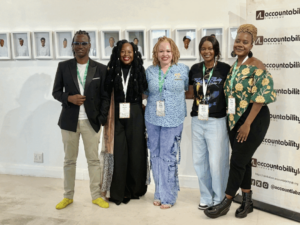
The afternoon sessions built on these reflections, offering space for creative demonstrations of advocacy through art. ALESA’s Arts for Change alumni, Ska Sebata, SOX the Poet, Rachel Kwainona, and Marve Tee, led fireside chat on artivism for people-centered governance. Each shared how their artistic practice has influenced communities and inspired social change. SOX the Poet reflected on how poetry, when combined with film and music, amplifies messages and connects with audiences in powerful ways. Ska Sebata showcased her globally screened film HER: A Disintegrated Notion, which merges film and fashion to tell women’s stories of resilience and emancipation in Zimbabwe. Rachel Kwainona and Marve Tee contributed through songs on social consciousness before engaging in dialogue which left some attendees with resolutions on how to creatively address social injustice through art.
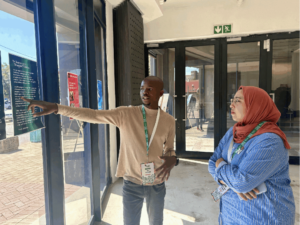 Adding another layer of depth to ALESA’s storytelling approach, Accountability Lab
Accountapreneur Zibusiso Munandi presented his visual exhibition Abangane: Stories, Voices, and Power in Healing under his initiative, the Abangane Platform. The exhibition centered on storytelling as a means of healing through shared narrative, creating space for young people and families to confront issues of mental illness, trauma, and stigma through openness and shared testimony. By shifting conversations from shame and secrecy to courage and connection, Abangane demonstrated how storytelling can help rewrite social narratives and foster collective healing. The project also reclaimed its voice by creating platforms where those often ignored, such as drug users, survivors, and vulnerable youth, could speak, be understood, and be part of building community-driven solutions.
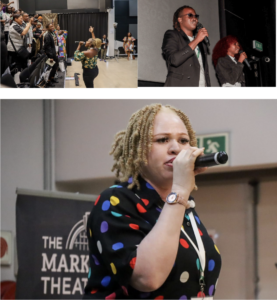
The conference’s creative energy was palpable throughout, but its most memorable moments came through live performances. The opening act by SOX the Poet and interlude performances by Bhanshee and Marve Tee captivated audiences, earning standing ovations. Their socially conscious performances embodied the conference theme, using art to explore justice, equality,
and empowerment. The performances reflected a shared understanding that storytelling is also about resistance, restoration, and reimagining power structures.
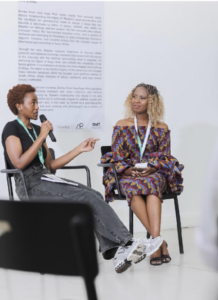
Beyond the stage, ALESA’s Marketing and Communications Officer moderated a side session
with South African multidisciplinary artist Ntandoyenkosi Maseko, who showcased her
photographic exhibition Stories from kwaGogo Ntuli. The conversation explored how storytelling through photography can preserve lineage, document marginalized voices, and serve as a form of archival justice. Maseko’s exhibition, featured in two rooms at the Market Theatre, traced her genealogy through photography, ensuring representation and recognition for those whose stories are often left out of history. For ALESA, this conversation reinforced the importance of inclusion and representation in governance storytelling, recognizing that accountability begins with visibility.
ALESA’s participation in Afrotellers 2025 offered valuable learning and reflection. The
experience reaffirmed that storytelling is a governance tool. Narratives make accountability
tangible, connecting policy and reform to lived human experience. Inclusion emerged as another
key insight, showing that when diverse voices and creative expressions are centered, governance work becomes more accessible, participatory, and authentic. Storytelling also proved to be a pathway to healing; it can restore dignity and build empathy, allowing communities to process trauma collectively while demanding justice.
Through film, poetry, performance, and conversation, ALESA continues to shape a future where creativity is both the language and the vehicle of accountability, where stories are lived, shared, and transformed into power.
– by Bathabile Dlamini | Media and Communications Officer