
NEWS
IN BRIEF
The launch of the National Disability Policy was hailed as […]
SHARE

The launch of the National Disability Policy was hailed as progressive and was anticipated to charter a pathway to inclusive societal transformation. The move rekindled a ray of hope for over a million persons with disabilities who happen to constitute the largest constituency under the category of minority groups. It became evident that Zimbabwe was poised to reclaim its rightful position as a leading champion of disability rights, considering its history, which dates back to the 1990s, when it became the first country to enact a disability law.
As part of efforts to fulfil the promise of creating a just, equitable and inclusive society, the policy proposed affirmative action measures such as ensuring that 15% of the workforce across all sectors comprises persons with disabilities, free provision and government regulation of assistive devices for affordability purposes and quality control, social protection to consider the economic cost of disability as well as the proposal to adopt a robust financing mechanism. This would include direct allocation of funds from the fiscal basket and the introduction of a Disability levy collected against every little fuel.
According to the Guidelines on CRPD-Compliant Disability-Inclusive Budgeting (CCDIB), funding for disability support services involves planning and allocating public budgetary resources to reduce and eliminate social barriers that hinder the full participation of persons with disabilities in the community. This ensures equal participation in the labour market, equal access to justice, and access to general and disability specific resources. The Africa Regional Social Protection Strategy of (2021 – 2025) stipulates that 4.5% of national budgets should go towards social protection programmes.
Since 2021, several tax reforms have been introduced, including the Sin Tax, Fast Food Tax, Wealth Tax, and Sugar Tax. The Ministry of Finance recently introduced the Digital Services Withholding Tax for 2026. Despite such annual reforms, the introduction of a disability levy, as stated in the policy, remains on paper, with no possibility of seeing how its implementation would strengthen disability support services to close the inequality gap and ensure easy access to disability-specific public services.
An analysis of budgetary allocations for social protection reveals that 2.1% of the budget went to social security in 2022, thus falling below the expected 1.5% of Gross Domestic Product. The percentage share allocation in 2023 decreased by 0.98% to 1.12%, as Zimcodd noted. Out of a budget allocation of 269.6 billion by mid-term, only 18% had been disbursed as of 30 September 2024. The same trend continued in 2025, when 11.7 billion was allocated, with only 30% disbursed as of September 30th. The recent national budget Presentation for 2026 shows an increase of 0.9 billion, bringing the total to 12.6 billion. The chronic and vicious cycle of underfunding for the Ministry of Public Service, Labour and Social Welfare, which violates international budgetary standards, has persisted.
Over the years, the Ministry of Public Service, Labour and Social Welfare has continued to face de facto underfunding, indicating that the government’s fiscal policy is one of austerity. This has left vulnerable members of society, including persons with disabilities, at the mercy of public goodwill due to weakened governance systems. The Zimbabwe Living Conditions Survey (2013) reports that approximately 85.6% of People with disabilities lack access to assistive devices. This is further validated by the National Assistive Technology Strategy of 2024, which stressed that access is minimal. Out of a targeted 1.7 million for the urban cash cereals programme, only 2.3% received cash disbursements of US$8.
Structural transformation, empowerment, and inclusive growth form the key pillars to realizing the country’s Vision 2030. This is embedded in the fiscal policy shift towards the progressive realization of disability rights, which includes adopting financing models such as implementing a disability levy, conducting a public sector audit on disability, and inclusive budgeting and public sector spending. Equal access to government-led public and disability-specific support services, such as assistive devices and social protection programmes that account for the economic cost of disability, is a step toward ensuring that people with disabilities live with dignity. Such efforts eliminate all forms of discrimination and inequality. Inclusive growth is a measure to guarantee access to economic opportunities. It is paramount that the 3 – 7% of Gross Domestic Product lost due to chronic economic exclusion of persons with disabilities, as stated by the International Labour Organisation, be reversed.
As the world commemorates the International Day of Persons with Disabilities, celebrated annually on the 3rd of December, this year’s theme calls upon the state to “Foster disability-inclusive societies for social progress“. Though Zimbabwe has made bold policy pronouncements, with the latest being the National Costed Plan of Action for the implementation of the National Disability Policy, the question remains whether the everyday experiences of persons with disabilities depict an inclusive and transformed society that enables full enjoyment of human rights and fundamental freedoms.
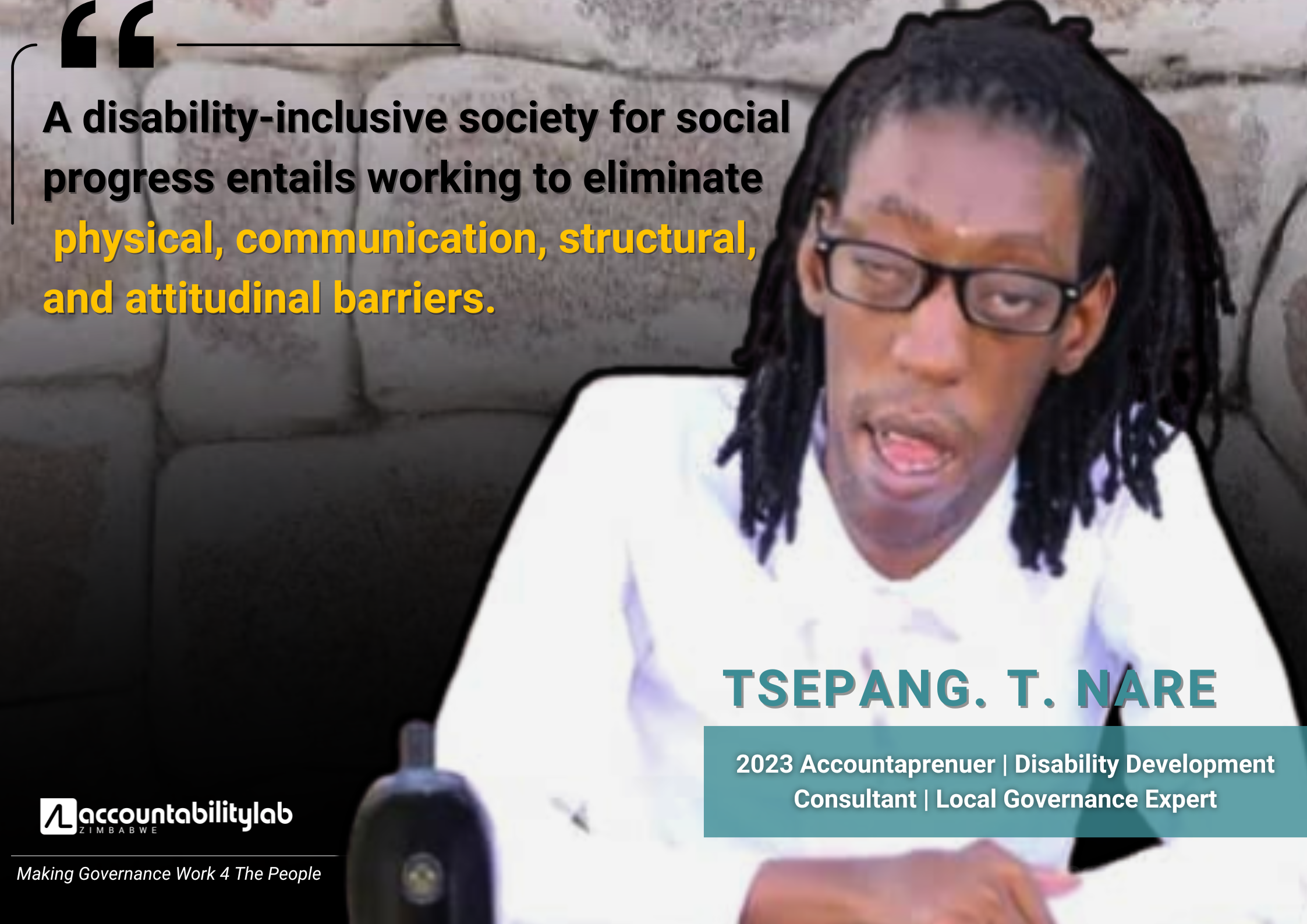
“A disability-inclusive society for social progress entails working to eliminate physical, communication, structural, and attitudinal barriers that have placed persons with disabilities in the doldrums of economic empowerment, thus limiting their self-determination, ” says Nare.
Entrenching a rights-based public finance management system ensures that every dollar spent beyond just social welfare spending contributes towards an accessible, equitable, and economically vibrant society. It all starts by quantifying the economic cost of fiscal exclusion of persons with disabilities to make efforts to build a just and inclusive culture where people with disabilities lead development.
Compiled by
Tsepang T. Nare
Disability Development Consultant and Local Governance Expert